

Tech companies may bring roughly $194 billion of AI-related bonds to market while the 30-year Treasury yield sits above 5%. That competition for capital is changing the AI trade — and keeping pressure on mortgages, stocks, and business loans.
America is trying to finance two mega-projects with the same pool of money.
The federal government must refinance old debt and sell new bonds to cover large deficits. At the same time, the technology industry is borrowing to build the data centers, chips, power plants, and grid connections behind artificial intelligence.
Reuters Breakingviews, citing a Wall Street estimate, put prospective hyperscaler bond supply at roughly $194 billion. Meanwhile, the 30-year Treasury yield closed Friday at 5.22%.
Those numbers are not directly comparable, but they reveal the problem: Washington and the AI industry are approaching many of the same pension funds, insurers, banks, and global investors. When more borrowers compete for that money, lenders can demand a better return.
AI is not the main reason Treasury yields are high. Inflation and federal borrowing matter much more. But AI has become a meaningful extra demand for capital at exactly the wrong time for anyone expecting rates to return quickly to the lows of the 2010s.
The AI trade is no longer just about who makes the best chip or model. It is about which borrowers can turn expensive infrastructure into enough cash flow to justify the debt.
What the Bond Market Is Saying
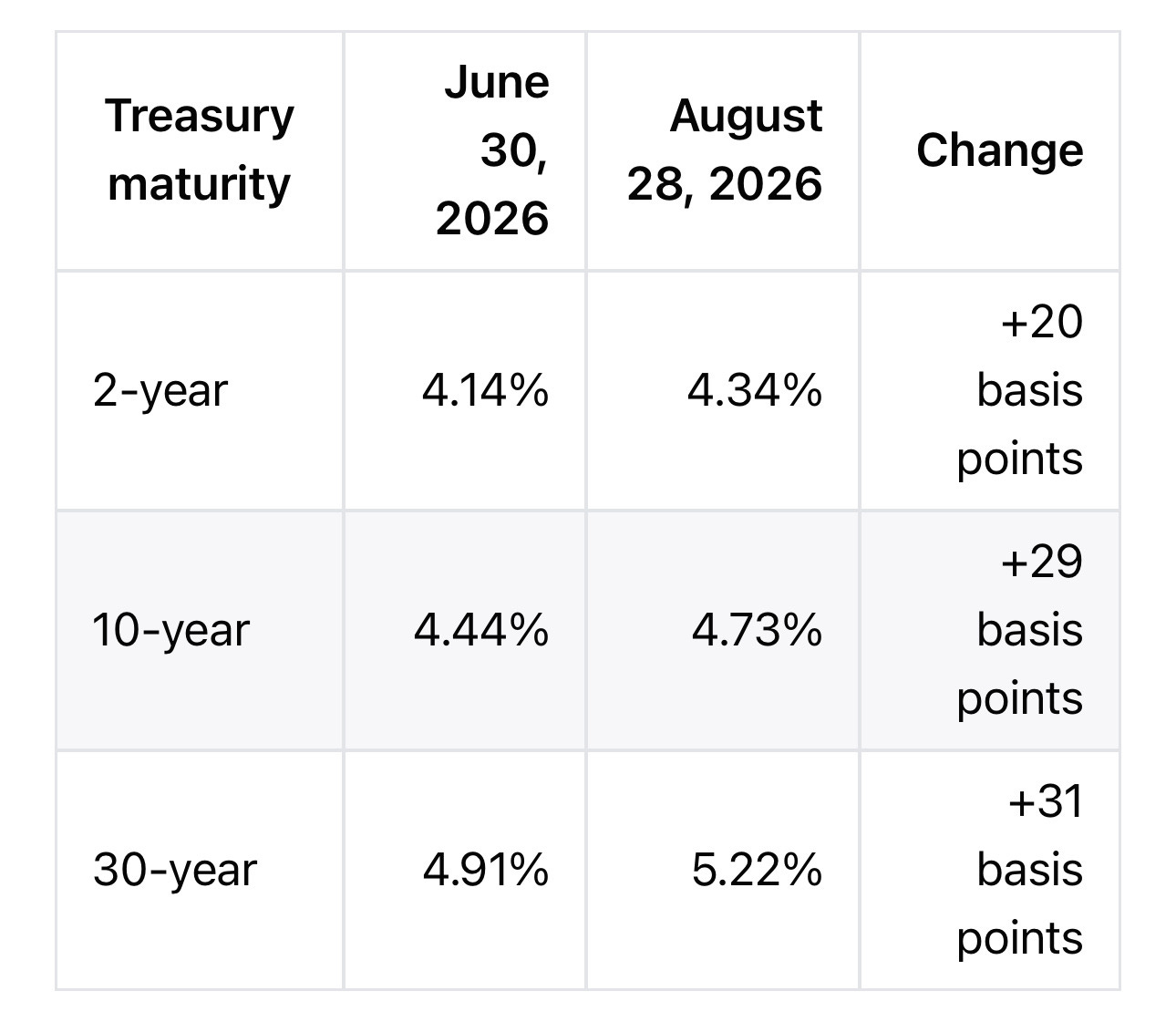
A 31-basis-point move may sound small, but it matters on a large mortgage, corporate refinancing, or government debt program.
The final week of August sent a more specific signal. The 30-year yield eased five basis points while the two-year rose 10. On Friday alone, the two-year jumped 14 basis points after Federal Reserve Chair Kevin Warsh spoke at Jackson Hole.
Warsh did not promise a rate increase. He said he was committed to "a discipline, not to a decision." But he also said inflation remained the Fed's predominant concern, financial conditions did not look broadly restrictive, and policymakers had "work to do" unless inflation moved toward 2% clearly and quickly enough.
The same day's data explained why. July inflation measured by the Fed's preferred PCE index was 3.7% from a year earlier. Core PCE was 3.3%.
Short-term yields are reacting to a Fed that cannot declare victory over inflation. Long-term yields must also account for deficits, heavy bond supply, economic growth, and the possibility that the AI buildout will keep demand for capital unusually strong.
Treasury Secretary Scott Bessent is trying to improve the long end's plumbing. Beginning September 9, Treasury will at least double liquidity-support buybacks in the 10- to 30-year sectors, from a maximum of $2 billion to at least $4 billion per operation through November 4.
The plan can make older bonds easier to trade and help dealers manage inventory. It is not quantitative easing: Treasury still has to finance the government, so buybacks can improve liquidity without erasing the deficit or the amount of debt investors must absorb.
Why AI Debt Matters
The first phase of AI looked like software. The current phase looks like a national construction project.
Advanced models need chips, buildings, cooling, fiber, and huge amounts of electricity. You can copy software almost for free. You cannot copy a power plant that way.
Individual bond transactions have been discussed at sizes as large as $25 billion. For context, Treasury sold $125 billion of 3-, 10-, and 30-year securities in its August refunding.
That comparison is not apples to apples: the Treasury figure covers one scheduled sale, while the AI estimate spans different companies and periods. But AI financing is now large enough to affect the same market where the government sets its borrowing cost.
Treasury yields are the benchmark for much of the financial system. Companies generally pay that rate plus extra yield for credit risk, so a higher Treasury rate makes the next AI bond more expensive before company-specific risk is added.
A high-grade AI bond may offer more income than a Treasury with a similar maturity, drawing some investors away from government auctions. Large corporate deals also generate Treasury-linked hedging and can force issuers to pay more. Once one major borrower pays up, similar bonds can reprice.
Higher hurdles: AI borrowing can add pressure to yields. Those higher Treasury yields then become the starting rate for the next data-center loan or bond.
A project that worked with a 4% borrowing cost may not work at 6% or 7%. The strongest developments will still get funded. Projects built around one major tenant, cheap refinancing, or perfect utilization become much harder to justify.
This is how the bond market can impose discipline on an investment boom without ending it.
The optimistic case is that the spending works. If AI raises productivity, companies can generate more cash, the economy can grow faster, and federal tax receipts can rise. The risk is that capital gets committed faster than projects can prove their return.
The Treasury market is still vastly larger than the hyperscaler bond market. AI is an amplifier of high yields, not their original cause.
The Investment Map
The useful distinction is not "bonds good" or "technology bad." It is who benefits from expensive capital and who depends on cheap refinancing.
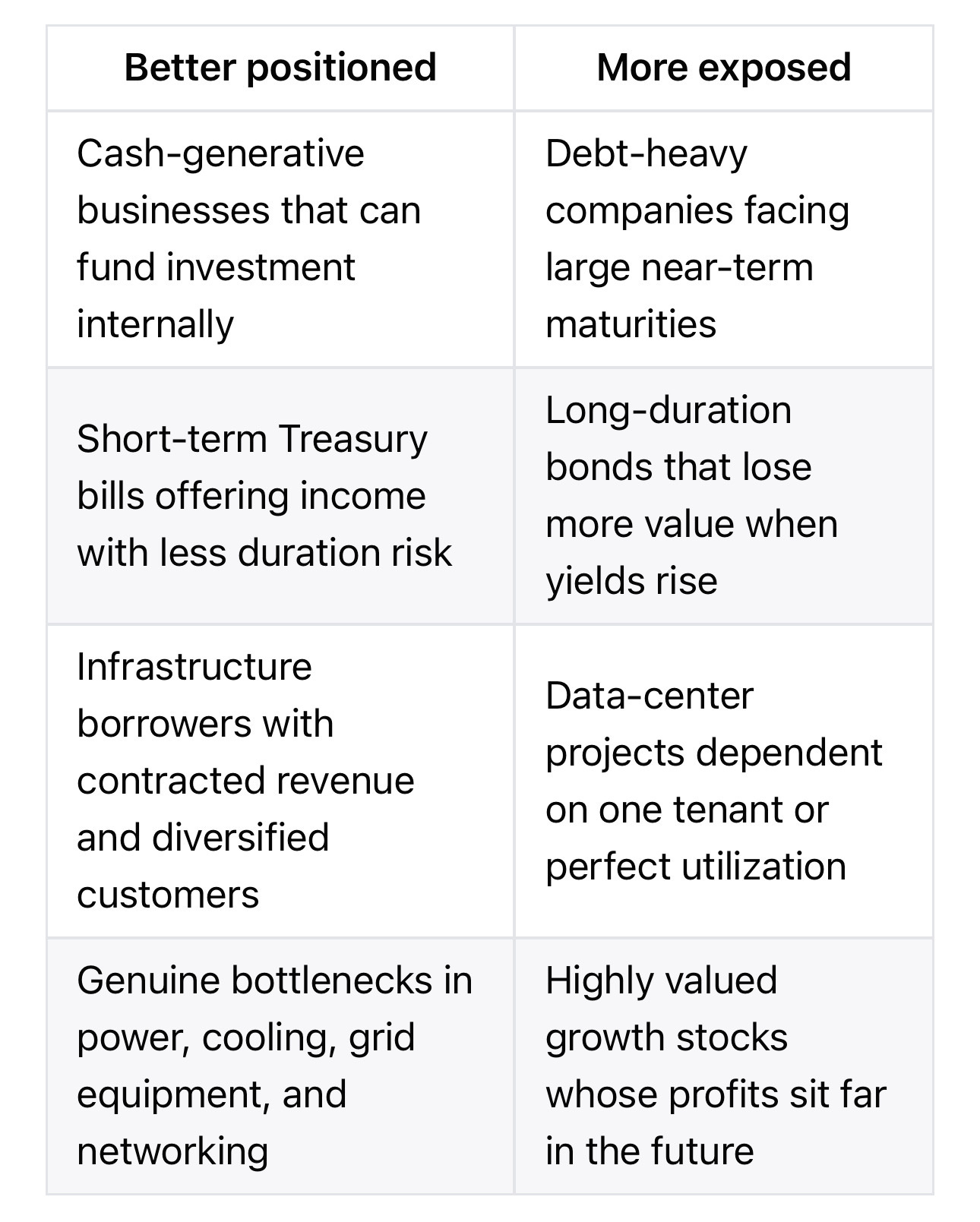
The cleanest AI trade may not be the company making the biggest spending announcement. It may be the business selling a scarce input into the buildout, generating cash today, and avoiding the need to refinance at next year's rate.
The most dangerous setup is the reverse: a long-dated promise financed with short-dated optimism.
Microsoft vs. CoreWeave: Same Boom, Different Balance Sheets
The recent stock performance looks surprisingly similar. Microsoft (MSFT) closed August 28 at $513.53, up about 10.5% in August and 5.3% this year. CoreWeave (CRWV) closed at $84.23, up about 17.4% in August and 14.0% this year.
The risk underneath those gains is not similar.
Microsoft produced $331.8 billion of fiscal 2026 revenue and $155.2 billion of operating income. Its existing businesses can fund much of the AI buildout even as spending climbs.
CoreWeave is using the capital markets more aggressively. In August, it closed a $2.6 billion loan priced at SOFR plus 5.5%, bringing its 2026 debt and equity financing above $30 billion. The loan lasts roughly five years, while the customer contracts supporting it average about three years. That leaves lenders and shareholders exposed to renewal and re-leasing risk.
CoreWeave has risen faster this year, but it also remains about 45% below its 52-week high. The lesson is not that Microsoft must outperform. It is that stock momentum can hide radically different financing risk.
What to Watch — and How It Reaches Your Wallet
Treasury auctions and Bessent's buybacks: Weak auctions or short-lived buyback relief would keep long-term yields high. That means pressure on mortgages and on growth-stock valuations, even if the Fed eventually cuts short-term rates.
AI bond sales and free cash flow: Larger concessions or widening credit spreads would show investors demanding more compensation. That raises refinancing costs for businesses far beyond AI and exposes projects that depend on cheap debt.
Power financing: Watch whether utilities charge data centers directly for new generation and grid upgrades. If regulators let those costs spread across the customer base, households will help finance the AI boom through higher utility bills.
The Bottom Line
Jackson Hole made clear that the Fed is not ready to relax while inflation remains well above 2%. Long-term rates face an additional problem: Washington and the AI industry both need enormous amounts of money.
The trade is to favor real cash flow, strong balance sheets, scarce infrastructure, and manageable refinancing risk. Avoid projects that require cheap debt, perfect utilization, and patient investors all at once.
AI may become one of the most productive investments of the century. Before it gets there, it still has to pay today's bills and clear the bond market.
This article is for informational and educational purposes only. It is not investment advice or a recommendation to buy or sell any security. Treasury yields and market data are as of the August 28, 2026 market close and may change.