
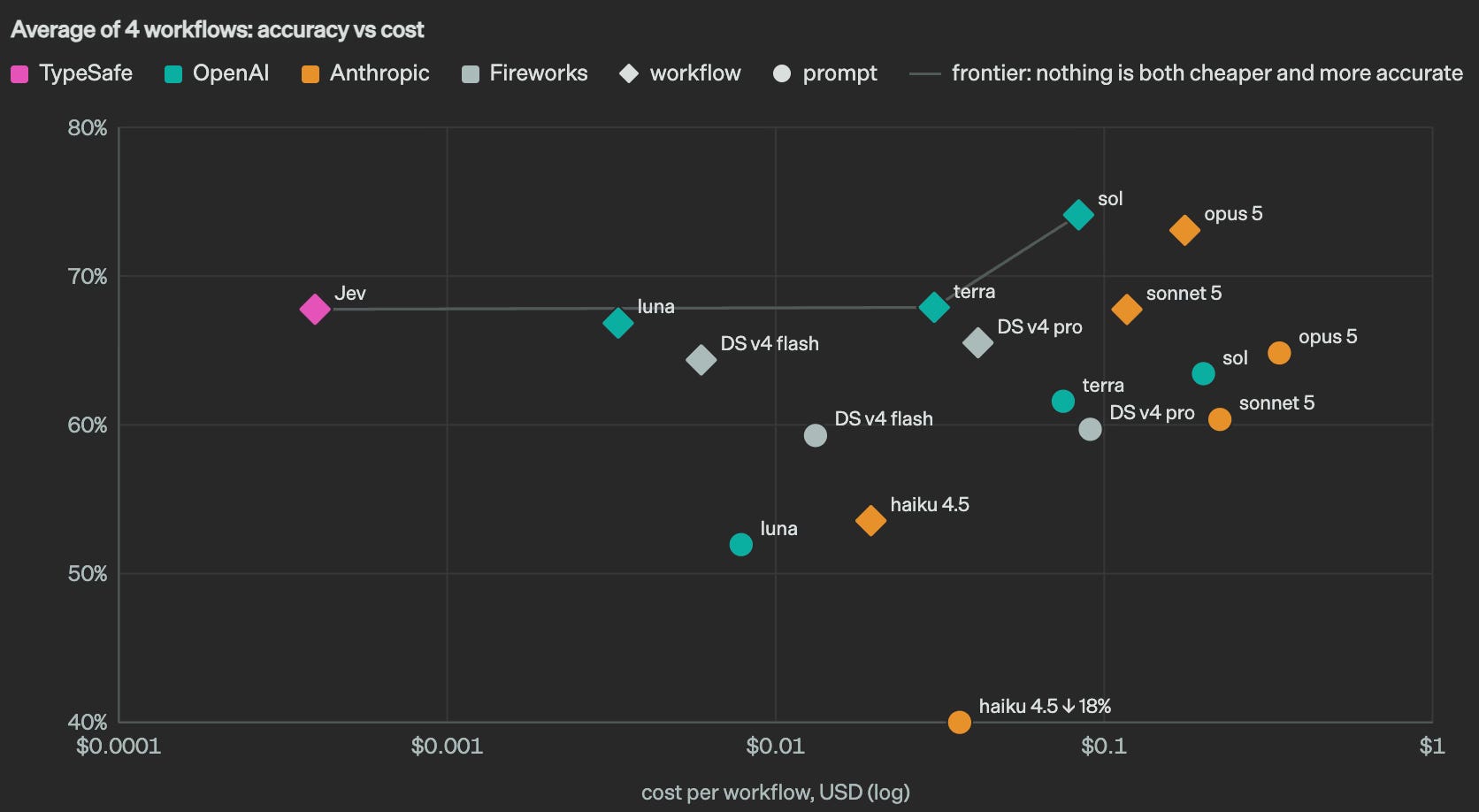
TypeSafe AI is betting that much of business automation needs a fast judgment, not a conversation, and the competition is heating up.
A customer writes: "I was charged twice."
Before anyone drafts an apology, the software needs to answer some less glamorous questions. Is this a billing problem? Is the customer asking for a refund? Does someone need to review the account?
Those are decisions, not writing assignments. Yet one way to automate them is to ask a large language model to generate an answer, then turn that answer back into something the software can use.
Jev, a model from TypeSafe AI, starts from a different premise: what if the AI skipped the prose?
It reads the information, evaluates questions, and returns constrained choices or scores with probabilities. The surrounding software decides what happens next.
That could make a lot of AI-powered work faster and cheaper. It does not make the decisions infallible. Understanding that distinction is the key to understanding both Jev's potential and its hype.
The story is moving beyond launch demos. TypeSafe now has a major new funding announcement, a named production case study, and an analytics integration comparing Jev with OpenAI models. But OpenAI has also opened a directly competing Decisions API in public beta, while Microsoft has launched its own decision model. The question is no longer just whether Jev's approach works. It is whether the specialist can stay ahead as the incumbents adopt it.
An AI switchboard, not another chatbot
The simplest way to think about Jev is as an AI switchboard.
A chatbot might explain why a message belongs with billing. Jev can choose "billing" from the departments you provide and return probabilities for the alternatives. Your code can then send the message to the right queue.
Developers give it two things: the information to inspect, called state, and specific questions about that information. The state might be a customer message, a document, or a structured record containing several text fields.
Its three question types cover different jobs:
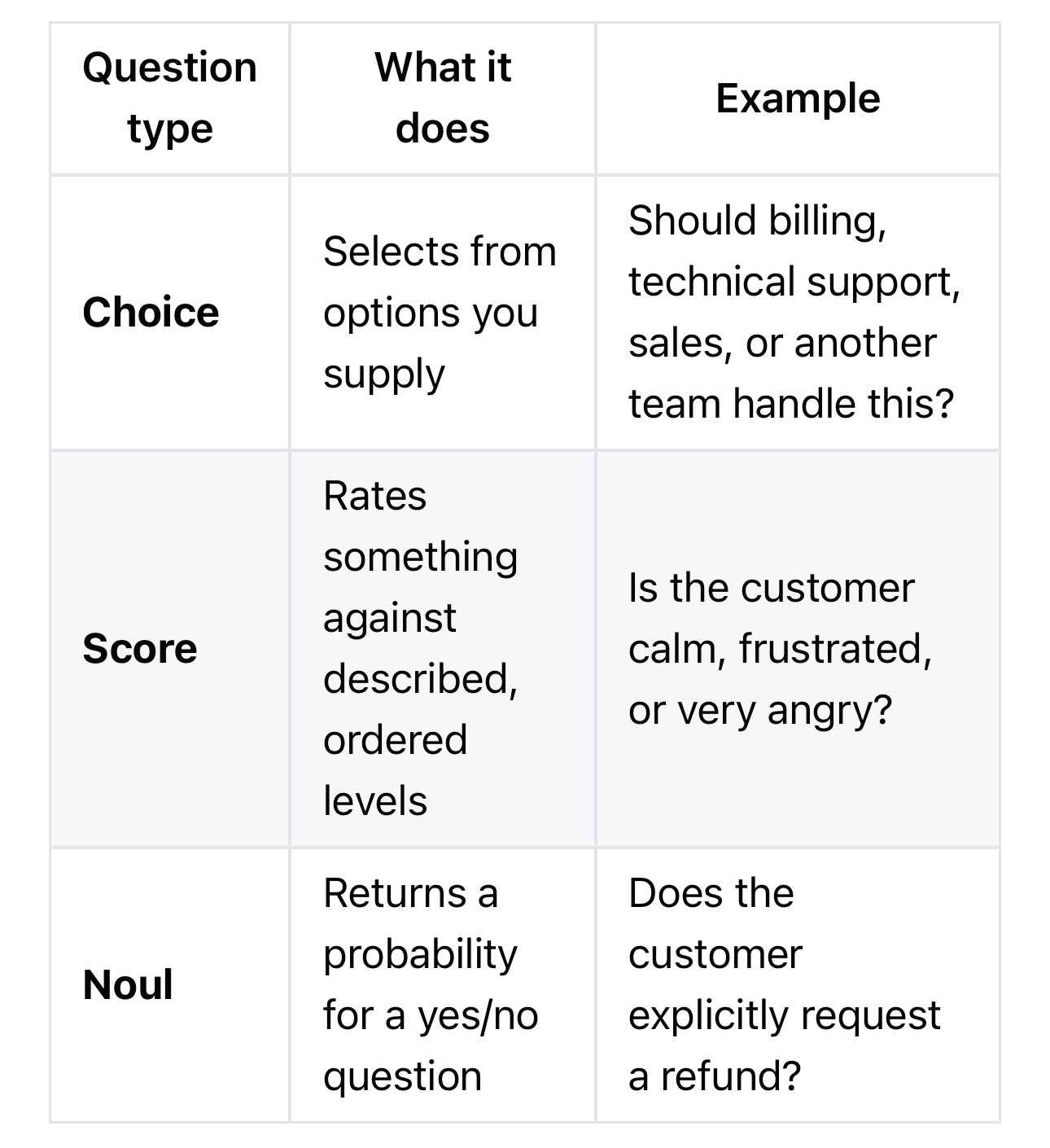
Choice and Score also return a confidence measure. Noul supplies the yes/no probability itself, without a separate confidence field.
Several independent questions can run together against the same information. Instead of asking one model to "analyze the customer and decide everything," developers can ask about urgency, department, and refund intent separately, then combine the answers in code.
The important word is independent. If one decision depends on an earlier answer, software still has to manage that sequence.
Nor does Jev take over the business. It can identify refund intent, but account permissions, payment checks, refund limits, and approval rules belong in ordinary software. It is a judgment component, not an autonomous manager.
Is it hype?
Classifiers are not new. Spam filters, document taggers, and sentiment models have been making bounded decisions for years.
Language understanding without text generation is not new either. BERT, introduced in research in 2018, helped establish a powerful approach: learn representations of language, then adapt them to tasks such as classification. Later approaches, including SetFit, showed how sentence models could be adapted with relatively few labeled examples.
Jev's proposed contribution is the package.
Instead of training a separate classifier for each fixed set of labels, a developer describes a question and its possible answers at request time. TypeSafe combines that flexibility with a decision-specific interface, parallel evaluation, explicit probabilities, and low published API pricing.
The company calls this a System One model, borrowing the fast, intuitive versus slow, deliberate distinction popularized by psychologist Daniel Kahneman. It is a design analogy, not evidence that Jev thinks like a person.
TypeSafe was founded in 2024 and announced Jev's selected-developer early access on September 15, 2026. Founder Diogo Almeida previously worked at OpenAI and coauthored the InstructGPT research that helped develop instruction-following models.
The name Jev comes from economist William Stanley Jevons. His famous paradox describes how greater efficiency can increase total resource use by making more uses economical. TypeSafe's bet is that cheaper machine judgment will make software use much more of it.
On October 9, Andreessen Horowitz published its announcement that it was leading an investment in TypeSafe. TypeSafe's corresponding announcement says the Series A raised $870 million at a $7.5 billion valuation, with participation from Sequoia Capital and existing investor DCVC.
Why Jev can be cheaper and faster
Generative models usually produce text one token at a time. Tokens are the small units providers process and bill for. Jev skips the prose; TypeSafe says its architecture evaluates questions and returns probabilities in parallel.
Jev 1.13's posted price is $0.042 per million input tokens, with output free. One million requests averaging 1,000 billable input tokens would cost $42 in model charges, before infrastructure, retries, or human review.
TypeSafe advertises 193.6 times faster and 444.6 times cheaper results in its launch workflows. But its team designed those tests, using other models' answers rather than independently verified labels. The company says the gains are probably near the upper end of real-world results. They do not establish an advantage over today's competing decision APIs.
The Jevify community benchmark offers a useful outside check: 192-millisecond median latencyacross a baseline covering 22,773 records. Accuracy was less consistent: 91.7% on BoolQ, a yes/no reading task, but 28.2% on its GoEmotions emotion-labeling configuration. These are different tasks, not a single intelligence score, and one setup cannot predict every workload. Fast, cheap judgment is useful only when it is accurate enough for the job.
Jev's competition: simpler tools and bigger labs
Jev's fairest opponent is the cheapest tool that does the job well enough, not the largest reasoning model.
For arithmetic, dates, and exact rules, that is usually code. For stable labels, a trained classifier may be fast, accurate, and inexpensive to run locally. Embedding models, which compare the meaning of texts, and small LLMs are also practical alternatives. Generative models already support constrained output formats, so valid labels alone are not Jev's advantage.
The big labs now compete more directly. OpenAI's Decisions API, opened in public beta October 6, uses GPT-6 Luna to return yes/no probabilities, choices, and scores from text or images. Its base price is $0.10 per million input tokens, with output free: about 2.38 times Jev's input rate, not hundreds of times higher. Regional and long-context adjustments can apply.
Microsoft-Decision-1 offers similar decision types through Foundry and OpenRouter at $0.042 per million input tokens, with output free, matching Jev's advertised rate. Microsoft's favorable benchmarks remain vendor claims, not proof of superiority on every workload.
Claude Haiku 5.5, released October 7, competes on flexibility. It handles classification and routing while retaining writing, image understanding, and tool use. Base pricing is $0.10 per million input tokens and $0.50 per million output tokens for prompts up to 100,000 tokens, with higher rates above that. One model that classifies a message and drafts the reply may be simpler to operate than two specialized services.
That is the incumbent advantage: customers can add decisions inside an existing provider relationship. Jev must offer enough benefit to justify another vendor.
Compare cost per correct decision, not token prices alone. Test accuracy, uncertainty, latency, retries, and human-review costs on the same workload. Jev could still win as a fast filter or router ahead of a generative model, but cheap typed outputs are no longer unique to it.
What people are actually building
The practical examples are more useful than the sweeping claims.
Support routing is an obvious fit. So are document classification, relevance filtering, and deciding which model should handle a request.
Candidate-based extraction is especially instructive. In a TypeSafe cookbook, regular expressions first find possible emails, phone numbers, or amounts. Jev selects the candidate that serves the requested role, and code copies and normalizes it.
Developers are also experimenting with model supervision. Jev can score a message or proposed tool action, while the application decides whether to allow it, block it, or ask for review. Because Jev itself can be influenced by adversarial text, it should not be treated as an impenetrable security boundary.
Vercel uses it for command-safety comparison with results five to 18 times faster and more accurate than the model being replaced. A Bryo CTO's business-email test found Gemini slightly more accurate but 10 to 20 times more expensive than Jev.
LangChain also has a real TypeSafe integration for incorporating these decisions into workflows, including experimental model-routing and tool-risk middleware.
The verdict
Jev deserves interest, and for suitable workloads it deserves a serious trial.
It has a coherent product idea, low published pricing, functioning integrations, and third-party evidence of useful performance. The latest funding and deployment claims add substance, but OpenAI's decision beta and Microsoft's matching price remove any easy claim that Jev stands alone. It does not have a demonstrated universal advantage over every classifier, uniformly reliable probabilities, or a guarantee against wrong decisions.
Its significance may turn out to be less about inventing a new kind of intelligence than about making the right kind easier to put into software. Whether TypeSafe becomes the winning supplier is a separate question.
The useful rule is simple: don't buy a conversation when you need a decision, and don't mistake a well-formatted decision for a correct one.