
Situational Awareness turned a prescient AI forecast into a 1,000% gain—then discovered that leverage can destroy a good thesis before the thesis has time to play out.
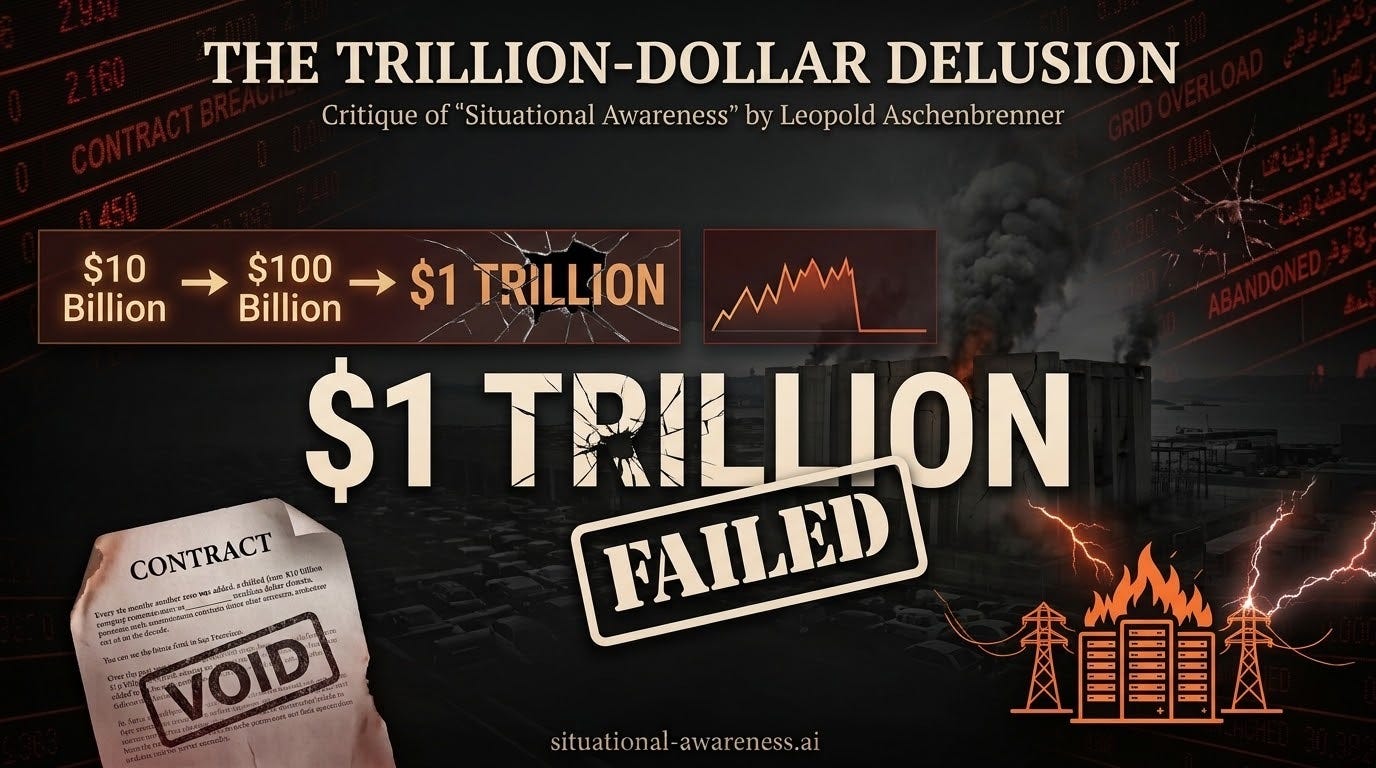
Situational Awareness reportedly gained more than 1,000%. Then it lost an estimated 67% in a single month.
That reversal did not happen because the AI boom ended in July. Data centers were still being built. Demand for memory and power had not disappeared. The fund simply could not survive a sharp move against an extremely concentrated, leveraged portfolio.
This is why the story matters beyond one hedge fund. The AI trade can be directionally right and still become uninvestable at the wrong price, position size, or level of leverage.
The next phase of AI investing may not reward whoever has the boldest forecast. It may reward whoever can stay solvent while the forecast plays out.
How the AI Trade Worked—and Broke
The strategy grew out of Aschenbrenner's 2024 essay series, Situational Awareness: The Decade Ahead. Its central argument was that increasingly capable AI would require an industrial mobilization: trillions of dollars for advanced chips, memory, electricity, and data centers.
That forecast became two connected bets. The fund went long the companies supplying the AI buildout—memory chips, data-center capacity, electricity, and other infrastructure—and reportedly shorted software companies Aschenbrenner believed AI would disrupt.
The fund's June 30 filing showed a $20.24 billion long U.S. securities portfolio. About three-quarters of its disclosed value sat in five exposures: Sandisk, Micron, Bloom Energy, Nebius, and CoreWeave. Sandisk and Micron alone accounted for more than $11 billion.
For a while, both sides worked. AI-infrastructure stocks soared, leverage magnified the gains, and exceptional performance attracted investors and copycats. But the portfolio hid several versions of the same economic bet behind different ticker symbols. Memory chips, data centers, and power suppliers may look diversified on a spreadsheet. They can still fall together when investors reduce exposure to AI infrastructure.
Leverage made the structure more fragile. It allowed the fund to control more assets than its investor capital could otherwise support. That boosts returns when prices rise, but it gives lenders influence over the timing of a sale when prices fall.
Think of leverage as a landlord who can evict you during a market storm. An unleveraged investor can decide a decline is temporary and wait. A leveraged investor may get a margin call and have to sell immediately.
Being right in five years does not matter if the portfolio cannot survive five days.
In July, infrastructure stocks fell while software shares rallied. The fund lost money on both sides at once. Falling collateral led to margin demands, forcing it to sell into a declining market. Citadel reportedly bought much of the leveraged public-equity book in a distressed block transaction.
Situational Awareness said it was not liquidated or shut down. Its July 31 investor letter estimated that the fund remained up roughly 80% for the year despite the 67% July loss. It closed its shorts, removed its dependence on financing, and continued in a smaller, unleveraged form.
How the Unwind Hit the Market
Situational Awareness did not cause a broad stock-market crash. Semiconductor and momentum trades were already reversing after an extraordinary run, overseas technology shares were also falling, and the S&P 500 remained close to a record.
The fund was an accelerant, not the original fire.
Its forced selling probably deepened losses in several crowded AI names, particularly stocks with less liquidity. Once traders suspected that a large, leveraged holder had to sell, the fund's well-known positions became easier to avoid or trade against. The same public filings that had served as a map for copycat investors now identified where selling pressure might appear.
The rebound was equally revealing. Sandisk, Bloom Energy, and CoreWeave reportedly jumped more than 20% after the distressed transaction cleared much of the forced seller from the market. Their businesses had not transformed overnight. What changed was the supply of stock for sale.
That distinction matters. Stock prices reflect both business fundamentals and market plumbing: collateral, leverage, liquidity, and positioning. During a forced unwind, the plumbing can temporarily overwhelm the business story.
The August 21 closing prices show how extreme the trade remained even after the correction:
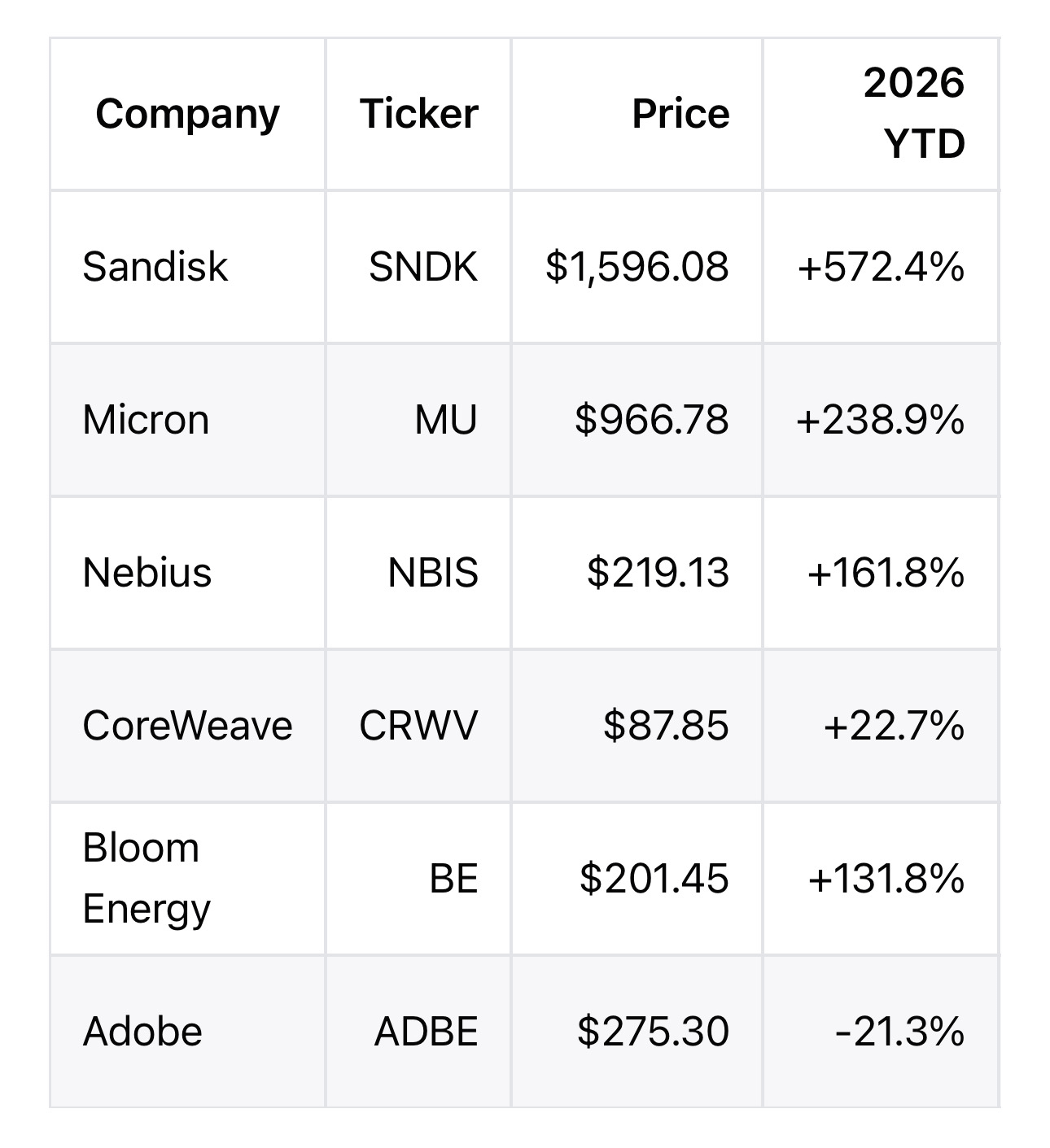
The table explains both the fund's success and its vulnerability. Several core holdings remained up by triple-digit percentages after the correction, while Adobe's rally hurt the short book. The thesis had become profitable, popular, and crowded at the same time.
The exact scale remains uncertain. The 67% July loss came from an unaudited investor letter, and estimates of leverage as high as 400% do not consistently define what was measured. It is also impossible to isolate the fund's precise impact on the selloff because semiconductor and momentum trades were already reversing.
What the Unwind Reveals About the AI Trade
Saying "leverage is dangerous" is true but incomplete.
Aschenbrenner may still be directionally right about AI. Demand for compute, memory, data-center capacity, and electricity could continue rising for years. A hedge fund can nevertheless lose most of its capital while expressing that correct view through too much concentration and borrowed money.
The backgrounds behind both funds made their success look unusually credible. Aschenbrenner was a former OpenAI researcher who worked on superalignment before his widely read AI manifesto established him as a prominent forecaster. LTCM founder John Meriwether was a celebrated Salomon Brothers bond trader who assembled leading Wall Street traders and financial economists, including Robert Merton and Myron Scholes, who received the 1997 Nobel Prize in economics for their work on derivatives valuation.
That intelligence was real, but it was not enough. Technical expertise can identify a powerful trend or a pricing mismatch; it cannot guarantee that markets will move on schedule, that lenders will keep extending credit, or that crowded positions can be exited without moving prices. Both funds learned that analytical ability does not replace position sizing, liquidity planning, and protection against extreme scenarios.
The episode has therefore been compared with LTCM, but it was not the same kind of crisis. LTCM's global derivatives exposure threatened major counterparties and market functioning. Situational Awareness made a directional equity bet whose unwind hurt a concentrated group of AI stocks without freezing credit or requiring a regulator-facilitated rescue.
The real lesson is that four different skills often get confused:
Forecasting: identifying where technology is going.
Stock selection: finding the companies that can capture the value.
Valuation: deciding what that future is worth today.
Portfolio construction: surviving long enough to be right.
Situational Awareness may have excelled at the first skill. The collapse came from the fourth. It did not cancel a data center or erase demand for memory chips, but it exposed four weaknesses investors should watch.
Different AI stocks can be the same trade.Chipmakers, data-center operators, power suppliers, and cooling companies occupy different parts of the supply chain. But they all depend on continued AI capital spending. Owning one of each is not real diversification if they all fall when expectations for the buildout weaken.
Valuation now matters as much as demand. A company can have booming sales and still be a poor investment if its stock already assumes years of flawless growth. This matters most for capital-intensive businesses that depend on high valuations or ready access to debt to fund expansion.
Crowding can overwhelm fundamentals. When many funds own the same stocks, losses in one position can force sales in another. A delayed 13F filing only shows what a manager owned weeks ago. It does not reveal shorts, leverage, financing terms, cash, or whether the manager is already heading for the exit.
AI is becoming an industrial trade. The opportunity now extends beyond model developers and chip designers to memory, electricity, grid equipment, construction, cooling, networking, and financing. Power plants and transmission lines cannot scale like software. The companies controlling genuine bottlenecks may capture the value. Businesses built on easily replicated capacity may not.
The Investor Playbook
The cleanest takeaway is not "sell AI." It is to separate the durable beneficiaries from the trades that require perfect conditions.
Favor bottlenecks with real cash flow.Memory, power, cooling, and networking can remain attractive when capacity is genuinely scarce—but valuation and balance-sheet strength matter.
Watch financing, not just demand. A data-center company can have a full order book and still struggle if debt becomes expensive or equity markets close.
Avoid borrowed conviction. The more compelling a theme feels, the easier it is to justify concentration and leverage. That is exactly when position sizing matters most.
Do not copy 13Fs blindly. You are seeing an old, incomplete snapshot without the manager's hedges or exit plan.
Keep dry powder. Forced sellers can create better entry prices for investors who do not share their deadline.
The most useful signals to watch are:
whether chip and infrastructure earnings continue to justify capital spending;
whether data-center financing remains available after stock volatility;
whether electricity and grid constraints delay projects;
whether AI customers begin demanding clearer returns on their spending;
and whether highly valued suppliers can keep growing without repeated capital raises.
These indicators will reveal more about the durability of the AI boom than the daily movement of any one AI basket.
The Bottom Line
Situational Awareness is not evidence that the AI trade is over. It is evidence that a powerful thesis can become a dangerous portfolio.
The opportunity remains in the bottlenecks: memory, power, cooling, networking, and data-center infrastructure. But the winners will not simply be the companies with the strongest AI narrative. They will be the businesses with scarce capacity, real cash flow, and enough balance-sheet strength to survive a reset in expectations.
For investors, ask three questions before buying any AI beneficiary:
How much future growth is already in the price?
How many other investors own the same trade?
What could force me—or the company—to sell or raise money at the worst time?
Seeing the future is useful. Surviving the path to it is what gets paid.
Disclaimer: This article is for informational and educational purposes only. It is not investment advice, a recommendation to buy or sell any security, or a substitute for advice from a qualified financial professional. Investing involves risk, including the possible loss of principal. Stock prices, returns, and market data are as of the August 21, 2026 market close and may have changed since publication. Figures describing Situational Awareness include unaudited management estimates, press reports, and public filings that do not show the fund's complete portfolio or leverage. Readers should verify current information and conduct their own research before making financial decisions.