
AI is not just rewarding the companies that make the brains of the system. It is increasingly rewarding the companies that make the part that keeps those brains fed with data.
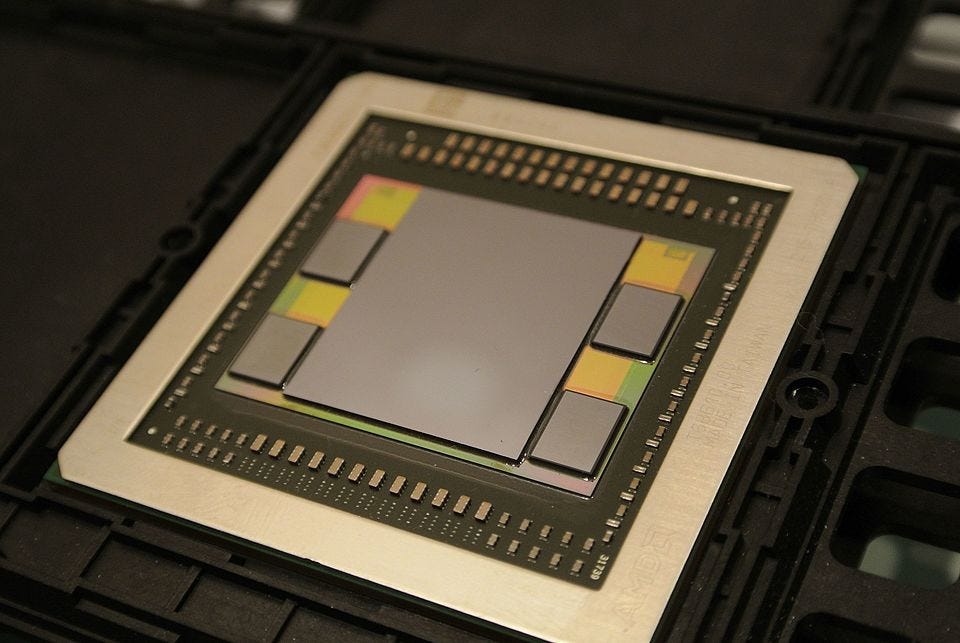
HBM sits close to the processor package so AI systems can move data much faster than with conventional memory layouts.
If you have been watching the semiconductor market lately, you have probably noticed a shift. The excitement is no longer just about GPUs. Memory stocks have been surging too. By early May 2026, Micron was up about 90% year to date, SK hynix was up roughly 121%, and Samsung Electronics was up about 92%. Even over the prior month alone, Micron had gained about 44%, SK hynix about 64%, and Samsung nearly 24%.
At first glance, that seems odd. Memory has long been treated like a commodity, the quieter and less glamorous side of computing. But in the AI boom, memory has become one of the industry’s most important choke points.
That is the real reason these stocks are rising. The market is starting to understand that AI systems do not just need more compute. They need far more memory, far faster memory, and far more advanced packaging around that memory. When supply cannot keep up, the companies that make those components gain pricing power, stronger margins, and, at least for a while, unusually favorable economics.
The Simple Version
Think of a computer like a kitchen.
The processor is the cook.
Memory is the counter space where ingredients are laid out and used right now.
Storage is the pantry where ingredients are kept when they are not actively being used.
Older computing workloads could get by with a modest counter. AI needs an industrial kitchen.
Large AI models have to move huge amounts of data quickly. That means they need more active working memory and more bandwidth between the processor and the memory. If the processor is fast but the memory cannot feed it data quickly enough, the expensive chip ends up waiting around. That is the “memory wall” the industry keeps talking about.
Once memory becomes the bottleneck, it stops being a background component. And when a bottleneck appears in a concentrated industry, the suppliers of that bottleneck usually do very well.
Why Memory Stocks Are Rising: Five Big Reasons
1. AI servers use enormous amounts of memory
The first reason is simple scale. Modern AI servers use far more memory than the average consumer device or older enterprise server. Some of the newest Rubin-class AI systems can pair a single GPU with up to 288GB of next-generation HBM4 memory. That is a very different world from a smartphone with 8GB or 12GB of memory, or even a typical consumer laptop.
The more advanced the AI system, the more memory it tends to need. Memory determines how much model data can be held close to the chip, how many users can be served at the same time, and how large a context window an AI model can support. If you want faster, smarter, and more useful AI, you usually need more memory.
2. The most important AI memory is difficult to manufacture
The memory getting the most attention right now is HBM, or high-bandwidth memory. HBM is a specialized kind of DRAM built for speed. Instead of sitting farther away on a motherboard like conventional memory, it is stacked in layers and placed close to the GPU or AI accelerator. That lets the system move data much faster.
But HBM is harder and more expensive to make than ordinary memory. Industry executives have described it as a trade-off where one bit of HBM can effectively displace about three bits of conventional memory production. That matters because the AI boom is not just creating new demand. It is also pulling capacity away from the rest of the memory market.
That is why a shortage in AI memory can spill into mainstream electronics.
3. There are only a few major suppliers
This is not a market with dozens of interchangeable producers. Supply is heavily concentrated among Micron, Samsung, and SK hynix. In a tight market, that matters.
When demand surges in a fragmented industry, buyers can shop around. When demand surges in a three-player market, suppliers have more leverage. That is one reason investors are rewarding memory makers: scarcity inside a concentrated market tends to boost pricing power.
4. Packaging is part of the shortage too
Many investors initially thought the AI boom would mainly benefit logic chipmakers and foundries. But the current squeeze is broader than that. AI demand is bottlenecking not just advanced semiconductor nodes, but also 2.5D and 3D packaging, including CoWoS capacity and related materials.
That matters because a lot of the value in modern AI hardware is not just in the chip itself. It is in how the chip, memory, substrates, and packaging fit together. A company can have demand for more memory, but if packaging or test capacity is constrained, supply still cannot ramp fast enough.
That is why companies like SK hynix are investing not just in front-end memory production, but also in packaging and test infrastructure such as its P&T7 facility.
5. Big AI customers are still willing to pay up
Cloud providers are not buying memory the way ordinary consumers buy RAM sticks. They are buying it because their AI businesses depend on it. If the economics of AI services still look attractive, they will absorb higher component costs rather than slow deployment.
That is already visible in earnings season. Microsoft now expects about $190 billion in 2026 capital expenditures, with roughly $25 billion of that tied to higher component prices. Apple has also warned that memory costs will increasingly affect its business. When customers of that size keep buying despite sharply higher prices, suppliers benefit.
The Memory Terms That Actually Matter
People use the word “memory” loosely, but for this story the distinctions are straightforward.
DRAM is the standard short-term working memory in computers and servers. It is the desk space a machine uses for active work.
HBM is a faster, more specialized form of memory stacked close to AI chips. This is the category most closely tied to the AI boom because it helps feed GPUs data fast enough.
LPDDR is lower-power memory used mostly in phones, tablets, and thin laptops. It matters here mainly as a reminder that not all memory demand comes from AI servers.
NAND flash and SSDs are storage rather than active working memory. They still benefit from AI demand because all of that training data and model output has to live somewhere.
The key takeaway is that when investors talk about the memory crunch behind these stocks, they mostly mean high-end DRAM and especially HBM, with storage as a secondary beneficiary.
Why Consumers Should Care
Here is the chain reaction.
First, AI demand explodes. Model builders, cloud providers, and enterprises all want more AI compute.
Second, AI chips require lots of HBM and other high-end memory. Suppliers prioritize those higher-margin products.
Third, because HBM uses up manufacturing and packaging capacity, there is less supply left for conventional DRAM and other products.
Fourth, device makers such as laptop and phone companies face higher input costs.
Fifth, those costs show up in one of three ways:
higher prices,
lower base configurations,
or lower profit margins.
That is how an AI infrastructure boom can show up in consumer hardware, even if the buyer never touches a data center.
This is not just a market story. It has real-world effects.
Microsoft has already raised Surface prices by hundreds of dollars due to memory and component costs. Apple has warned that memory costs are becoming a bigger factor, and premium-device price increases are one obvious response. The broader consumer electronics market is under pressure because higher memory costs eventually feed into end-device prices.
Even when sticker prices do not move much, the value proposition can still worsen. Manufacturers can keep the same headline price while reducing the amount of included memory, pushing buyers toward more expensive versions. They can also steer customers into premium configurations where margins are better.
For enthusiasts and professionals, the pain can be even more obvious. In one widely cited example, 256GB of RAM that cost roughly $300 a few months earlier later had an implied value of around $3,000. That is an extreme case, but it captures the broader point: memory is suddenly not cheap anymore.
The Bottom Line
From an investor’s perspective, this is close to an ideal setup for memory makers, at least in the short run.
Demand is strong.
Supply is constrained.
Customers are price-insensitive.
The industry is concentrated.
The highest-growth products carry better economics.
That combination is why memory suppliers have been posting standout results. SK hynix has reported record revenue and profit, driven by high-value AI memory. Micron has also indicated that it is effectively sold out for 2026 across key memory categories tied to servers and AI infrastructure.
Investors are not just buying the idea of more units sold. They are buying the prospect of stronger pricing, better product mix, and unusually high earnings leverage.
There is an important catch, though: memory has always been cyclical.
The same industry that looks unbeatable during a shortage can look oversupplied a few years later. New fabs, new packaging lines, and new equipment eventually show up. Current industry forecasts point to some easing in packaging constraints by 2027. Micron has new fabs planned for 2027, 2028, and beyond. SK hynix and TSMC are expanding aggressively too.
That means the bullish thesis can be right today and still weaken later. Investors need to watch for the turn.
The most important warning signs are:
faster-than-expected capacity relief,
weaker AI capital spending,
consumer demand that does not recover,
or evidence that pricing has peaked.
Step back, and the bigger picture is straightforward.
Memory stocks are soaring because memory has become one of the most important bottlenecks in the AI economy. AI systems need massive amounts of fast memory, especially HBM, and the industry cannot expand supply quickly enough because the constraints run from fabrication to packaging to materials. That is pushing up prices, improving supplier margins, and shifting investor attention upstream to the companies that control scarce capacity.
For non-technical readers, the main lesson is simple: AI is not just a story about powerful processors. It is also a story about the memory that keeps those processors fed with data. When that memory becomes scarce, the companies that make it can become some of the biggest winners in the market.